Galvanized Pipe Problems in Baltimore Homes Repair or Replacement
Learn when Baltimore galvanized pipes need repair or replacement, warning signs, costs, timelines, risks, and how to choose the right plumber.
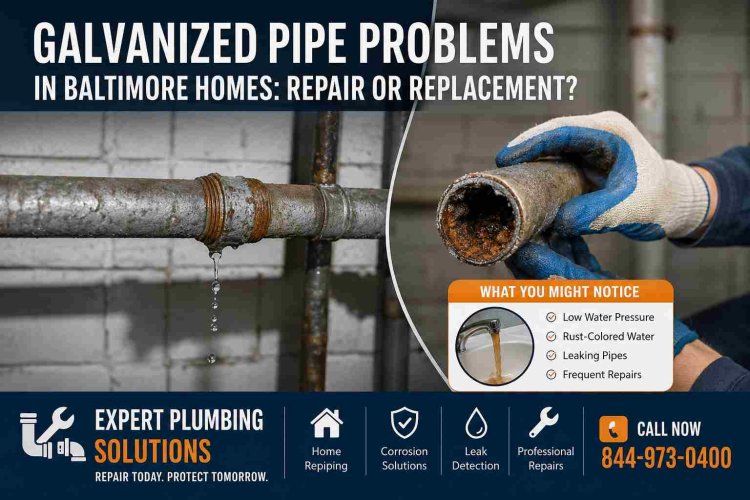
Galvanized steel plumbing was widely used in older American homes because the steel was coated with zinc to help protect it from corrosion. Many older Baltimore homes, including rowhouses and properties built several decades ago, may still have galvanized water-supply pipes hidden behind walls, beneath floors, or exposed in basements.
The problem is that galvanized piping does not last forever. As the zinc coating wears away, the steel underneath can begin corroding from the inside. Rust and mineral buildup gradually reduce the pipe's interior diameter, restricting water flow. Eventually, corrosion can lead to pinhole leaks, failed threaded connections, discolored water, or a complete pipe failure.
For Baltimore homeowners, the important question is often not simply, "Do I have galvanized pipes?" It is whether the existing plumbing can reasonably be repaired or whether replacement is the better long-term solution.
This guide explains the warning signs, causes, repair options, replacement process, expected timelines, cost factors, maintenance steps, and situations that require emergency plumbing help. If you suspect your home's galvanized pipes are deteriorating, an inspection by a qualified plumber can help determine how serious the problem is.
What Are Galvanized Pipes?
Galvanized pipes are steel pipes coated with zinc. The zinc layer was intended to slow corrosion and extend the useful life of the steel.
They were commonly installed in older homes for:
- Cold and hot water supply lines
- Basement plumbing
- Bathroom supply lines
- Kitchen plumbing
- Laundry connections
- Outdoor water connections
- Older service-line installations
The major weakness is that corrosion can continue underneath the surface even when the outside of the pipe appears reasonably intact.
Inside an aging galvanized pipe, rust and mineral deposits can accumulate over time. The opening through which water travels becomes smaller, which explains why an older home can have acceptable water pressure at one fixture but very weak flow at another.
Why Do Galvanized Pipes Fail in Baltimore Homes?
The primary problem is corrosion.
When the protective zinc coating deteriorates, the steel becomes increasingly exposed to water and oxygen. Rust forms on the interior surface, and deposits can accumulate on top of the corrosion.
Several factors can accelerate deterioration, including:
- Age of the plumbing
- Water chemistry
- Repeated exposure to moisture
- Corrosion around threaded fittings
- Previous plumbing modifications
- Connections between different metals
- Mechanical stress
- Existing leaks or damaged sections
In older Baltimore properties, accessibility can also make repairs more complicated. Rowhouses and finished basements may have plumbing routed through tight spaces, walls, ceilings, or masonry.
Baltimore-area pipe replacement can therefore cost more when access is difficult or when a larger portion of an older plumbing system needs to be replaced. Current Baltimore cost data also notes that older homes with galvanized or lead-related plumbing and rowhouses with difficult access can require more extensive work.
What Are the Warning Signs of Galvanized Pipe Problems?
Galvanized pipe deterioration often develops slowly, so homeowners may notice several smaller symptoms before a major failure occurs.
1. Low Water Pressure
If water flow has gradually become weaker, internal corrosion may be restricting the pipe.
You may notice:
- A weak shower
- Slow-filling toilets
- Reduced kitchen faucet flow
- Poor flow from multiple fixtures
- Hot water that seems weaker than before
If several fixtures are affected, the problem may be farther upstream rather than limited to one faucet.
2. Brown, Yellow, or Rust-Colored Water
Rust-colored water can occur when corrosion or sediment inside old pipes becomes disturbed.
It may be particularly noticeable:
- After water has been sitting overnight
- After the water has been shut off
- When a valve is opened
- Following plumbing work
Discolored water should not automatically be blamed on galvanized pipes, however. Water-main work, fixtures, service lines, and other plumbing components can also contribute.
3. Recurring Leaks
A galvanized pipe that has already developed one leak may have significant corrosion elsewhere.
A temporary repair may stop water from escaping at one location while another weak section remains.
4. Visible Rust
If exposed galvanized pipes show heavy rust, flaking, bulging, or corrosion around threaded connections, the plumbing deserves professional evaluation.
5. Frequent Plumbing Repairs
If you repeatedly pay for repairs to the same old water-supply system, replacement may eventually become more practical than continuing to patch individual failures.
Can Galvanized Pipes Be Repaired?
Yes, sometimes.
A plumber may be able to replace a damaged section when the surrounding pipe remains structurally sound and accessible.
For example, a small localized leak in an exposed basement pipe may be repairable without replacing the entire plumbing system.
However, galvanized pipe can create a difficult repair situation because corrosion may be much worse inside the pipe than it appears from the outside. Old threaded fittings can also become fragile.
Trying to force apart heavily corroded connections can cause additional damage.
That is why a professional should evaluate the condition of the surrounding piping before recommending a simple patch.
When Is Galvanized Pipe Replacement Better?
Replacement becomes more attractive when corrosion is widespread rather than isolated.
A plumber may recommend repiping when the home has:
- Multiple leaking galvanized sections
- Consistently poor water flow
- Severe internal corrosion
- Repeated plumbing failures
- Corroded threaded fittings throughout the system
- Extensive rust buildup
- Pipes approaching or exceeding their practical service life
- Plumbing that is difficult to repair repeatedly
Replacing one short section can make sense when the rest of the system is healthy. Replacing an entire run may make more sense when several connected sections are already deteriorating.
The decision should be based on the condition of the plumbing, not simply the age of the house.
Does Galvanized Pipe Pose a Drinking-Water Concern?
Old galvanized plumbing deserves attention when drinking-water quality is a concern.
The U.S. Environmental Protection Agency explains that lead particles can attach to galvanized pipe surfaces and may later enter drinking water. Certain galvanized pipes can therefore be relevant when evaluating lead exposure, particularly where they are connected to or have historically been downstream of lead plumbing.
This does not mean every galvanized pipe automatically contains dangerous levels of lead.
If you are concerned about drinking-water safety, do not rely only on the appearance of the pipe. A qualified plumber and appropriate water testing can help identify the actual situation.
EPA also recommends testing drinking water when homeowners want to know whether lead is present.
What Is the Professional Repair Process?
A professional galvanized-pipe repair generally begins with inspection rather than immediately cutting into the plumbing.
Step 1: Identify the Pipe Material
The plumber examines accessible piping and determines whether it is galvanized steel, copper, PEX, PVC, or another material.
Step 2: Locate the Problem
The plumber determines whether the issue involves:
- One fitting
- One pipe section
- Multiple branches
- A main water line
- The home's complete supply system
Step 3: Check Water Flow and Pressure
Testing helps determine whether corrosion is restricting water delivery.
Step 4: Evaluate Pipe Condition
The plumber looks for corrosion, leaks, damaged threads, sediment buildup, and other signs that the existing system may be approaching failure.
Step 5: Recommend Repair or Replacement
If the damage is localized, a section may be replaced.
If deterioration is widespread, repiping may provide a more reliable long-term solution.
Step 6: Install Compatible Materials
Depending on the home's design and applicable plumbing requirements, replacement piping may use modern materials such as PEX or copper.
The correct transition fittings are important when connecting different pipe materials.
How Long Does Galvanized Pipe Repair Take?
The timeline depends heavily on accessibility and the amount of plumbing involved.
A straightforward exposed pipe repair may sometimes be completed during a single service visit.
More complicated work can take longer if the plumber must:
- Open walls or ceilings
- Access pipes beneath floors
- Work around finished spaces
- Replace multiple plumbing branches
- Reconfigure several fixtures
- Replace a larger section of the home's supply piping
A whole-house repipe is a significantly larger project than repairing one visible leak. Your plumber should explain the expected work area, water shutoff period, restoration requirements, and estimated completion time before starting.
How Much Does Galvanized Pipe Replacement Cost in Baltimore?
There is no reliable one-price answer because every home is different.
Current Baltimore estimates for pipe replacement show a broad range, with Angi reporting approximately $477 to $2,889 for pipe replacement projects and an average around $1,670, while noting that larger whole-house projects can cost substantially more.
Your actual cost can depend on:
- Number of pipes being replaced
- Pipe diameter
- Total linear footage
- Choice of replacement material
- Accessibility
- Basement or crawl-space conditions
- Finished-wall access
- Number of fixtures
- Labor requirements
- Whether permits or inspections apply
- Removal and disposal of old piping
- Drywall, flooring, or masonry restoration
A written estimate is much more useful than relying on a national average.
What Happens If You Ignore Old Galvanized Pipes?
Ignoring deteriorating galvanized pipes can turn a manageable plumbing project into an expensive emergency.
Potential problems include:
Water Damage
A failed pipe can release a large amount of water into a wall, ceiling, basement, or floor.
Mold and Structural Damage
Persistent leaks can contribute to damp building materials and secondary property damage.
Loss of Water Pressure
As corrosion builds inside the pipe, water flow may continue getting worse.
Sudden Pipe Failure
A pipe that has been leaking slowly may eventually fail more severely, particularly around an already weakened fitting.
Repeated Repair Costs
Continuously repairing individual leaks may cost more over time than planning a controlled replacement.
Are Galvanized Pipes an Emergency?
Not every galvanized-pipe problem requires emergency service.
A slow drip from an exposed pipe may allow you time to schedule a planned repair.
Emergency plumbing is more appropriate when:
- A pipe has burst
- Water cannot be shut off
- Water is rapidly entering the home
- A ceiling or wall is becoming saturated
- There is significant flooding
- Multiple fixtures suddenly lose water
- A major supply line fails
- You cannot safely control the leak
If water is actively flooding the property, shut off the home's main water supply if it is safe to do so and contact a plumber promptly.
Can You Temporarily Stop a Galvanized Pipe Leak?
Temporary measures can sometimes reduce immediate water loss, but they should not be considered a permanent solution.
Depending on the situation, a homeowner may be able to shut off the affected branch or main water supply.
Do not aggressively tighten heavily corroded fittings. Old galvanized connections can break unexpectedly.
Avoid treating tape, sealants, clamps, or other temporary measures as proof that the underlying pipe is safe. A temporary repair can buy time, but a professional should determine why the pipe failed and whether other sections are at risk.
How Can Baltimore Homeowners Maintain Old Galvanized Plumbing?
If replacement is not immediately necessary, regular observation can help you catch problems earlier.
Consider:
- Checking exposed pipes periodically
- Watching for rust or moisture
- Paying attention to declining water pressure
- Monitoring water color
- Inspecting accessible basement plumbing
- Repairing leaks promptly
- Avoiding unnecessary stress on old fittings
- Having aging plumbing professionally inspected
- Planning replacement before a major failure occurs
If your home is undergoing remodeling, it can also be a practical time to evaluate exposed galvanized piping before walls or ceilings are closed again.
People Also Ask About Galvanized Pipes
Should I replace all galvanized pipes in my Baltimore home?
Not necessarily. If corrosion is limited to one accessible section, a targeted repair may be reasonable. If multiple sections show deterioration, repiping may provide better long-term value.
How do I know if my house has galvanized pipes?
Look at accessible basement or utility-room plumbing. Galvanized steel is usually gray or silver and uses threaded fittings. A plumber can confirm the material and condition.
Can galvanized pipes cause low water pressure?
Yes. Internal corrosion and mineral buildup can reduce the effective opening inside an aging galvanized pipe and restrict water flow.
Is it better to replace galvanized pipes with PEX or copper?
Both can be appropriate depending on the home's layout, local requirements, budget, accessibility, and plumber's recommendation. The best material should be selected after evaluating the existing plumbing.
How long can galvanized pipes last?
Their useful life varies considerably based on installation, water conditions, corrosion, and maintenance. Age alone should not determine whether replacement is necessary; actual pipe condition matters.
Can galvanized pipes be connected to copper?
They can be connected when the transition is properly designed and the appropriate fittings are used. Improper connections between dissimilar metals can contribute to corrosion problems.
Voice Search Questions Homeowners Ask
"How do I know if my galvanized pipes need to be replaced?"
Look for repeated leaks, low water pressure, rust-colored water, visible corrosion, and multiple failing sections. A professional inspection can determine whether the damage is localized or widespread.
"Is it worth replacing galvanized pipes before they leak?"
If inspection shows widespread corrosion, planned replacement can be preferable to waiting for multiple emergency failures and water damage.
"How much does it cost to replace galvanized pipes in Baltimore?"
The price depends on the amount of piping, accessibility, materials, labor, and restoration. A local inspection and written estimate are the best way to establish the actual project cost.
"Can a plumber repair one galvanized pipe without replacing the whole house?"
Yes, if the damage is isolated and the surrounding piping is still in reasonable condition. If corrosion is widespread, a larger replacement may be recommended.
How to Choose the Right Baltimore Plumber
Do not choose a plumber solely because the estimate is the cheapest.
Before hiring someone for galvanized pipe repair or replacement, ask:
- Are you licensed and properly insured?
- Will you inspect the surrounding plumbing?
- Can you explain why repair or replacement is recommended?
- What pipe material will you install?
- How much of the existing system will be replaced?
- Is the estimate written and itemized?
- How long should the work take?
- Will water need to be shut off?
- Who handles required permits or inspections?
- Will walls, ceilings, or floors need to be opened?
- What warranty applies to the work?
A trustworthy plumber should explain the problem in plain language and give you enough information to make an informed decision.
Final Thoughts: Repair or Replace Your Galvanized Pipes?
Galvanized pipe problems rarely improve on their own. Corrosion can continue inside the pipe even when the outside looks acceptable.
A single leak does not automatically mean the entire plumbing system needs replacement. However, repeated leaks, severe rust, poor water pressure, and multiple deteriorating sections are strong reasons to have the system evaluated.
For Baltimore homeowners, the smartest approach is to identify the condition of the existing plumbing before an emergency occurs. A professional inspection can help determine whether a localized repair is sufficient or whether replacing aging galvanized piping is the more practical long-term investment.
If you need help evaluating galvanized pipes, leaks, low water pressure, or repiping options, contact Plumber in Baltimore at 844-973-0400 to discuss your plumbing needs.
What's Your Reaction?